
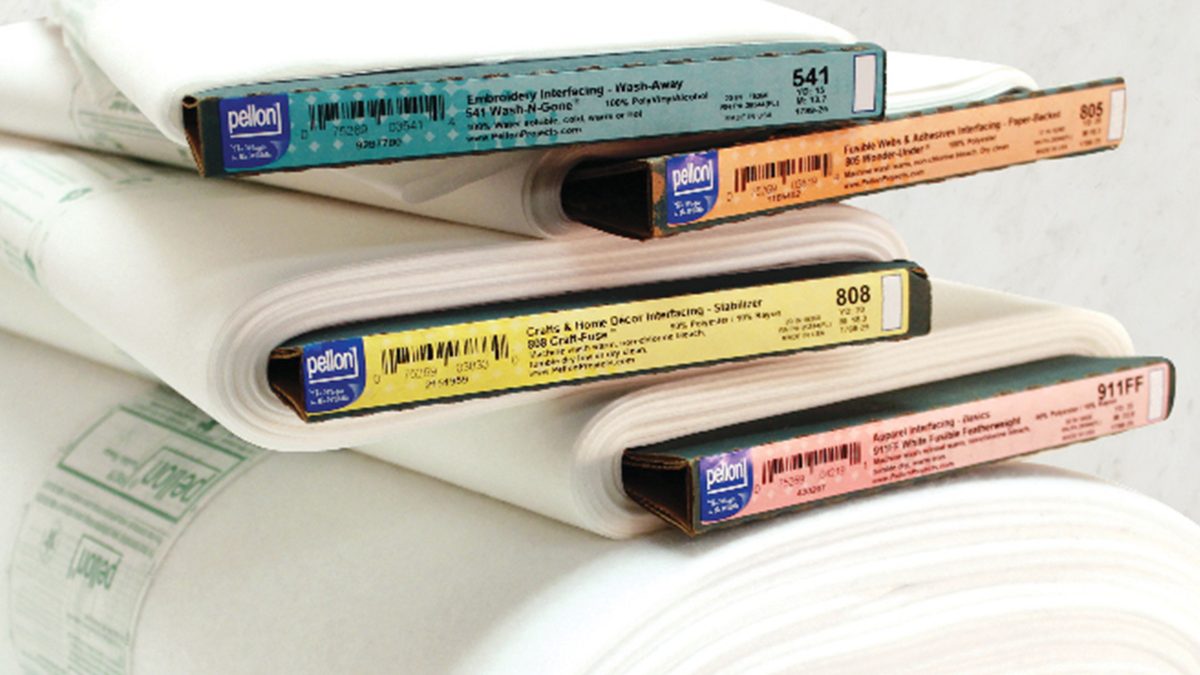

The other day, during the Instagram live we did, we talked about interfacing—what to use it for, when to use it, what it’s like… Here’s a summary of what we discussed. If you want to watch the video, you can find it on our IGTV channel here.
Let’s start with the definition of interfacing:
A piece of fabric (woven or nonwoven) applied to the inside of garments or accessories to give them shape, body, or reinforcement.
Weights:
Interfacing comes in different weights depending on its use, purpose, type of project…etc…

Woven Interfacing:
Made with thread, it can be cut on the straight grain or on the bias, depending on what you want to make. It can be fusible or non-fusible. There are many variations for woven fabrics and knits.
Nonwoven Interfacing:

It can be cut in any direction and doesn’t fray, so it can be used for all kinds of projects and works very well on curves. Within this type, there are different varieties: soluble, tear-away, for neckline and waistband finishes…
Fusible:
The interfacing has a layer of adhesive on one or both sides, allowing it to be applied with heat from an iron.
How do you iron it? We’ll always iron at the temperature appropriate for the type of fabric, plus a little more so the adhesive melts. We’ll work from the center outward to avoid wrinkles. Normally, we’ll do it without steam, although some brands may work well with steam. And we’ll always protect the fabric with a cloth (it can be damp) or kraft paper.

Non-fusible interfacing
This type of interfacing is for fabrics that can’t tolerate heat or that are very thin, where the adhesive could seep through and stain the fabric.
I hope this post has helped clarify the different types of interfacing available on the market :)